4,000 Years of Engineered Motion: A Brief History of Bearings
Every mechanical system has a point of dependency. Not the primary structure or power source, but the smaller components that enable controlled movement.
Bearings sit at the centre of that function. The history of bearings spans more than 4,000 years, with engineers continually refining how motion is controlled and friction is reduced. From ancient bearings used in early construction to precision-engineered components in modern machinery, the core principle has remained unchanged.
This is the story of the evolution of bearings and how bearings were invented into one of the most essential elements in engineering.
The Origins: Early Rolling Systems (3500 BC)
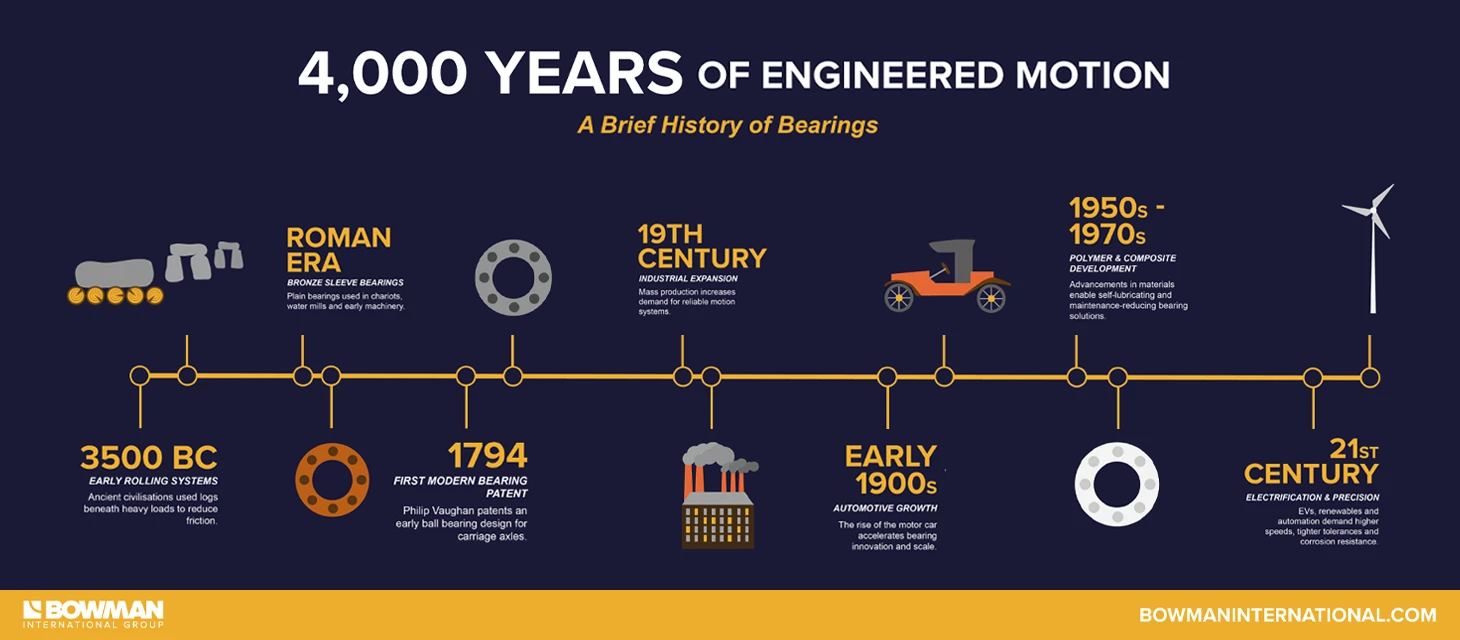
The earliest application of bearing principles began with a practical problem: moving heavy loads. Early civilisations were required to transport stone blocks weighing several tonnes. Dragging these loads created significant resistance, limiting both distance and control.
The introduction of logs placed beneath the load provided a simple but effective solution. By allowing the object to roll rather than slide, friction was significantly reduced.
While not engineered in a formal sense, the principle was clear. Replacing sliding motion with rolling motion reduces the force required to move an object and improves efficiency. These early systems are widely recognised as the foundation of ancient bearings.
Advancing Engineering: The Roman Era
Roman engineering introduced a more deliberate approach to friction management.
Rather than relying solely on rolling systems, they developed components designed to reduce resistance within mechanical assemblies. Bronze sleeve bearings, an early form of plain bearing, were used in applications such as chariots and water mills.
These systems relied on smooth surfaces and lubrication rather than rolling elements.
This marked an important shift. Movement was no longer simply enabled but controlled.
As mechanical systems became more complex, the need for reliability increased, and bearings became an integrated part of system design, advancing bearing history significantly.
A Turning Point: The First Modern Bearing (1794)
A significant development came in 1794, when Philip Vaughan patented the first ball bearing design for carriage axles.
This design introduced rolling elements positioned between moving surfaces, reducing friction more effectively than sliding contact alone. The result was smoother, more efficient motion and improved durability.
For the first time, bearing performance could be engineered with greater precision rather than relying solely on material selection or lubrication. The invention of the first ball bearing marked a defining milestone in the history of bearings.
Industrial Demand: The 19th Century
The Industrial Revolution accelerated the need for reliable mechanical components.
Machinery was no longer used intermittently. It operated continuously, under load, and at scale. This created new performance requirements. Components needed to last longer, operate consistently, and withstand increasing mechanical stress.
Bearing design evolved accordingly. Manufacturing processes improved, and early forms of standardisation began to emerge. Bearings became critical to maintaining operational continuity across industrial systems.
Accelerated Innovation: Early 20th Century
The expansion of the automotive industry introduced further demands on bearing performance. Higher operating speeds, continuous motion, and variable loads required components that could maintain precision under sustained stress.
This drove advancements in both design and manufacturing. Tolerances became tighter, and production methods improved to ensure consistency at scale.
Bearings were no longer peripheral components. They became directly linked to system performance and reliability.
Material Developments: 1950s to 1970s
Mid-20th century material innovation expanded the capabilities of bearing technology.
The introduction of polymers and composite materials enabled the development of self-lubricating bearings. These reduced maintenance requirements and improved performance in environments where traditional materials were less effective.
Improvements in wear resistance and corrosion resistance allowed bearings to operate reliably in more demanding and specialised applications. This period represented another important stage in the evolution of bearings.
Precision and Performance: The 21st Century
Modern engineering places significantly higher demands on bearing performance.
Applications such as electric vehicles, renewable energy systems, and advanced industrial machinery require components that can operate continuously under high loads and challenging conditions, often with minimal maintenance.
Manufacturing precision has improved substantially. Tolerances are tighter, performance is more predictable, and materials are engineered for specific operating environments.
Despite these advancements, the underlying principle remains unchanged.
Reduce friction. Enable controlled motion. Maintain reliability.
A Continuous Evolution
Over four millennia, bearing technology has evolved from simple rolling systems to highly engineered components designed for precision and durability. Materials, manufacturing processes, and application demands have all advanced.
The history of bearings demonstrates how continuous innovation has shaped modern engineering. From ancient bearings to the first ball bearing and today’s advanced solutions, bearing history reflects the ongoing evolution of bearings. Understanding how bearings were invented provides valuable insight into one of engineering’s most fundamental and enduring technologies.