Why Leonardo da Vinci Is Considered the Father of Modern Bearings
An Idea Before Its Time
Long before modern engineering, patents, or industrial manufacturing, one of the most fundamental problems in mechanics had already been explored.
“Friction.”
When asking who invented the ball bearing, many people think of modern industrial inventors. However, Leonardo da Vinci ball bearing concepts show that the core principles behind modern bearing design were being studied centuries before they were formally developed.
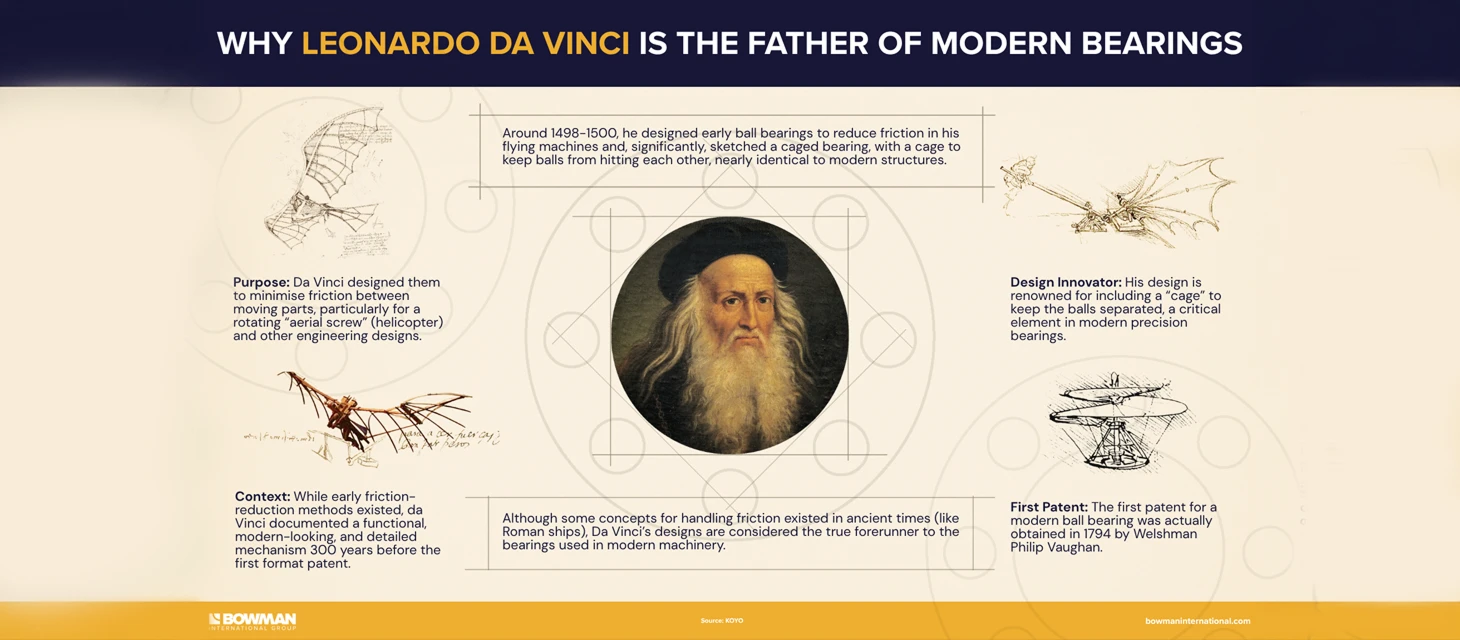
Between 1498 and 1500, Leonardo da Vinci sketched what is widely regarded as the first ball bearing design while examining motion and mechanical systems. His objective was straightforward: reduce friction between moving parts and improve efficiency in rotating mechanisms.
What makes this especially striking is how closely his designs resemble what we recognise today.
Solving a Fundamental Engineering Problem
Da Vinci approached friction as a practical engineering challenge.
In any machine with rotating components, friction leads to resistance, heat, and wear. Without a way to control it, systems quickly become inefficient and unreliable.
His sketches, particularly those linked to his aerial screw and other da Vinci inventions, show early attempts to solve this problem. He explored the use of rolling elements to separate moving surfaces, reducing direct contact and allowing smoother motion.
At a time when most mechanical thinking relied on simple sliding contact, this represented a significant shift in engineering design.
The Importance of the Bearing Cage
One of Leonardo’s most notable contributions was the concept of a bearing cage.
This element was designed to keep the rolling components evenly spaced, preventing them from colliding and ensuring consistent movement.
That same principle remains essential today.
Modern precision bearings rely on cages to maintain smooth operation, minimise wear, and perform reliably under load. It may seem like a small detail, but it is fundamental to how bearings function in real-world applications.
From Concept to Mechanism
Context is important.
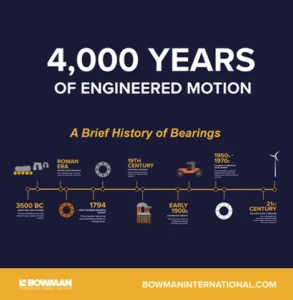
Efforts to reduce friction were not new. Early civilisations, including the Romans, developed basic methods such as lubrication and primitive rolling systems.
What set Leonardo da Vinci apart was his ability to document a complete and workable mechanism.
His drawings go beyond abstract ideas. They show structured systems designed to manage motion and friction in a controlled and repeatable way.
This was nearly 300 years before the first patent for a modern ball bearing and remains a defining milestone in the history of ball bearings.
The First Patent and Industrial Development
That milestone came in 1794, when Philip Vaughan patented a ball bearing design for carriage axles.
This marked the beginning of bearing manufacturing as an industry.
However, the underlying principle of separating moving parts with rolling elements and controlling their motion had already been explored centuries earlier through Leonardo da Vinci ball bearing concepts.
Why It Still Matters Today
Da Vinci’s designs were never produced at scale.
The materials and manufacturing techniques of his time simply were not advanced enough to support widespread application.
Even so, the engineering intent and understanding were clearly present.
He identified the problem, developed a practical solution, and documented designs that closely resemble modern bearing systems.
A Foundation for Modern Engineering
This is why Leonardo da Vinci is often regarded as the father of bearings.
Not because he commercialised the technology, but because he understood its engineering principles at a fundamental level.
He recognised how reducing friction could transform mechanical systems and developed concepts that continue to underpin engineering today.
For anyone asking who invented the ball bearing, the answer is nuanced. While Philip Vaughan received the first patent for a ball bearing, Leonardo da Vinci created the first ball bearing design centuries earlier, making his work one of the most important foundations in the history of ball bearings.