How the World Runs on Bearings: A Snapshot of the Global Market
The Hidden Component Behind Global Systems
Mechanical systems rarely fail at their most visible point. More often, failure begins with a smaller, less visible component.
Bearings sit at the centre of that dependency.
They are used across automotive systems, industrial machinery, transport networks, and renewable energy infrastructure. While they are rarely seen, their role is critical to the operation of modern engineering. The global bearing market reflects this importance, supporting industries that rely on precision, durability, and continuous motion.
The scale of this reliance is reflected in the market itself.
The bearing industry is valued at over $120 billion and supports systems that keep production moving, transport networks operating, and energy generation consistent.
This article provides a bearing industry overview, examining where the market stands today, what is driving demand, and how it is evolving.
A $120 Billion Industry with Steady Growth
The global bearing market operates on a significant scale.
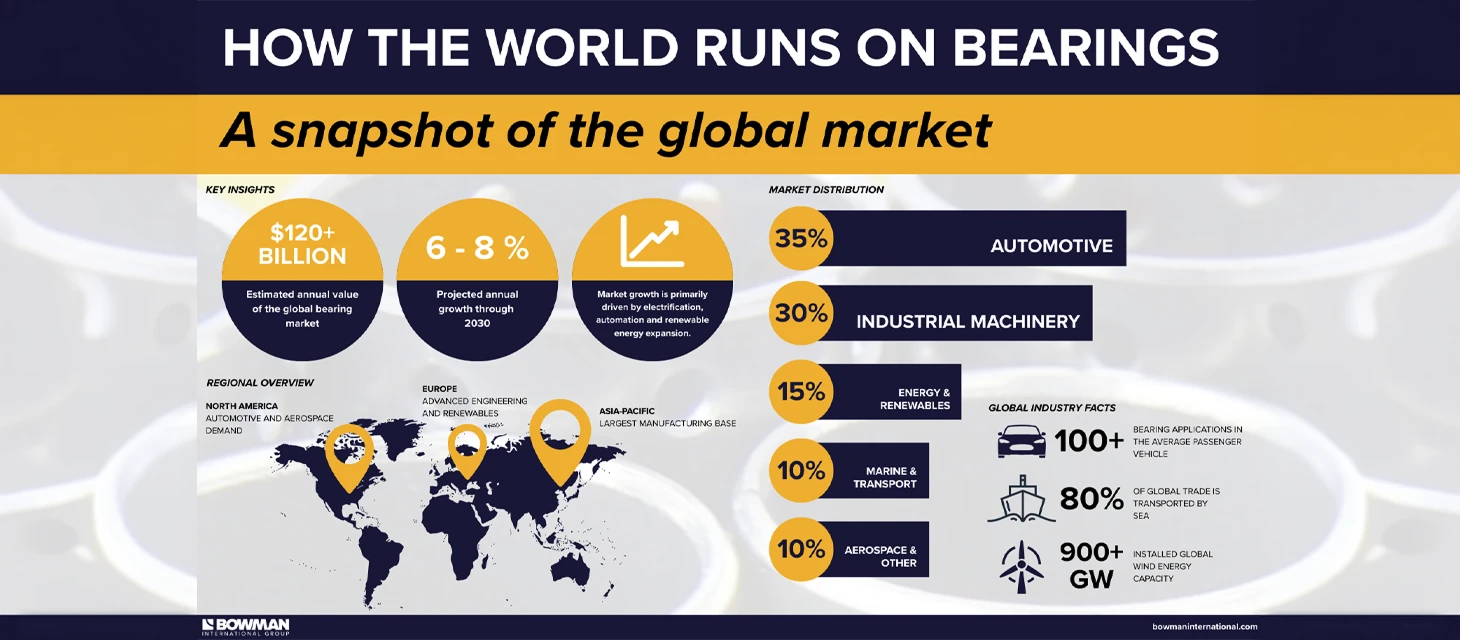
Current estimates place the bearing market size at over $120 billion annually, reflecting widespread use across multiple sectors. Bearing market growth remains steady, with projections indicating an annual increase of between 6 and 8 percent through 2030.
This growth is not driven by a single industry.
Instead, it is supported by broader structural shifts, including electrification, increased automation, and the expansion of renewable energy. Each of these areas depends on reliable, high-performance components to operate efficiently.
Bearings play an integral role across all of these bearing applications.
Where Demand Comes From
Industrial bearings demand is distributed across several key industries.
The automotive sector represents the largest share, accounting for approximately 35 percent of global demand. Bearings are used throughout vehicle systems, including drivetrains, wheels, and auxiliary components.
Industrial machinery accounts for around 30 percent of demand. In these environments, continuous operation and high loads place consistent requirements on durability and performance.
Energy and renewable applications make up roughly 15 percent of the market, with continued growth driven by the expansion of wind and other renewable technologies.
Marine and transport sectors contribute approximately 10 percent, where components must operate reliably in demanding and often corrosive conditions.
The remaining 10 percent consists of aerospace and other specialised bearing applications, where precision and operational reliability are critical.
A Global Industry Structure
The global bearing market operates across a globally distributed network.
North America is driven by demand from the automotive and aerospace sectors, with a strong focus on performance and advanced engineering standards.
Europe maintains a leading position in precision engineering and renewable energy, particularly in wind power and sustainability-led applications.
Asia-Pacific represents the largest manufacturing base and supports global supply chains through high-volume production.
These regions are interdependent, with design, manufacturing, and application spread across multiple markets.
Systems That Depend on Bearings
The importance of bearings becomes clearer when viewed within real-world systems.
A typical passenger vehicle contains more than 100 bearing applications, each contributing to overall system performance and reliability.
Approximately 80 percent of global trade is transported by sea. Ships operate continuously under load in demanding environments, where bearing reliability is essential.
Global wind energy capacity now exceeds 900 gigawatts, and each turbine depends on bearing systems to maintain efficient operation over extended periods, often in remote or exposed locations.
These are not isolated use cases. They represent critical systems that underpin global infrastructure.
Why It Matters
Bearings are rarely the focus of attention within engineering systems. However, their role is fundamental.
As industries continue to scale, automate, and operate under increasingly demanding conditions, industrial bearings demand will continue to increase alongside ongoing bearing market growth.
The bearing market size reflects the level of global reliance, while the breadth of bearing applications demonstrates the industry’s impact.
Together, these factors highlight a simple reality.
Modern systems depend on components that are often overlooked, and among them, bearings remain essential to keeping the world in motion.